


Tomahawk TG3000i-BRV 3000W Camo Inverter Generator | E-Moto Charging & Backup Power
Tomahawk TG3000i-BRV 3000W Camo Inverter Generator | E-Moto Charging & Backup Power
SKU: SKU:TG3000i-BRV
Tomahawk TG3000i-BRV 3000W Camo Inverter Generator | E-Moto Charging, Camping & Backup Power
The Lightweight 3kW Inverter, Now in Camo
The Tomahawk TG3000i-BRV Camo Special Edition takes the portable 3,000W inverter generator platform and gives it a rugged camouflage finish that fits right in at the track, campsite, trailhead, hunting camp, or remote jobsite. For e-moto riders, it also hits a useful sweet spot: enough continuous power for many higher-output chargers and additional equipment without stepping up to a large, heavy generator.
With 3,000 rated watts, 3,300 starting watts, 120V output, and less than 3% total harmonic distortion, the TG3000i-BRV provides clean inverter power for compatible e-moto chargers, tools, appliances, computers, speakers, lighting, and other sensitive electronics.
Despite that output, the generator weighs just 53 lbs and measures 20 x 12 x 19 inches. Add a 1.1-gallon fuel tank, up to 8 hours of runtime at half load, a 62 dBA noise rating, and parallel capability, and you've got a portable power source that can pull double duty for riding weekends, camping, work, and emergency backup.
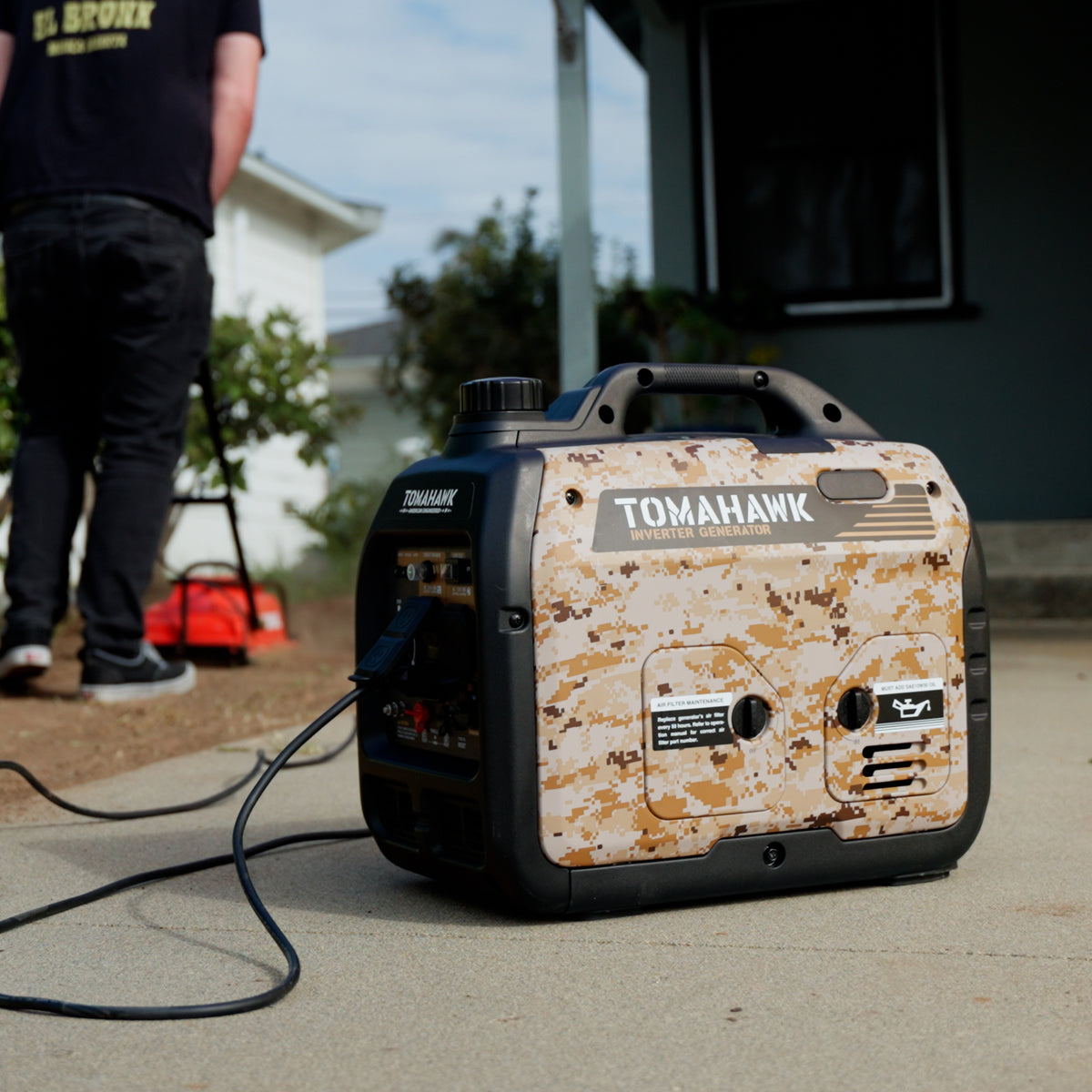
Camo Power Anywhere
The Camouflage Special Edition gives the TG3000i-BRV a more outdoor-focused look without sacrificing the portability that makes this generator useful in the first place. Load it into the truck for a weekend of riding, keep it around camp, or bring it to a remote jobsite when dependable 120V power isn't nearby.
For e-moto riders in particular, this is a convenient way to bring charging capability with you instead of planning the entire day around finding an outlet.

3000 Watt Clean Inverter Power
The TG3000i-BRV provides 3,000 rated watts and 3,300 starting watts. Its advanced inverter technology maintains less than 3% total harmonic distortion, producing clean, stable power for compatible battery chargers and sensitive electronics in addition to traditional tools and equipment.
That 3,000W continuous rating is particularly useful for e-moto charging. It gives riders more room for higher-output chargers or additional equipment compared with smaller portable generators, while the compact size keeps the generator practical to transport.

Two 120V Outlets
The TG3000i-BRV features two 120V GFCI-compliant receptacles for compatible e-moto chargers, tools, lights, appliances, electronics, jobsite equipment, and other 120V loads.
If you're charging your bike while also running camp or pit equipment, remember that everything plugged into the generator contributes to the total load. Add those requirements together and leave reasonable headroom below the generator's continuous output.
Built for More Than Charging
This isn't just an e-moto charger with an engine attached to it. Tomahawk designed the TG3000i platform for demanding portable-power applications. The 5HP industrial-grade engine is paired with fuel-saving technology, while overload protection, low-oil shutdown, GFCI protection, and built-in surge protection help protect the generator and connected equipment.
If your power needs grow, the TG3000i-BRV is also parallel capable, allowing compatible TG3000i generators to be connected for increased available output.
2-Year Warranty
The Tomahawk TG3000i-BRV is backed by a 2-year warranty and support through Tomahawk's nationwide service network.
What Size Generator Do I Need for My E-Moto?
Choosing a generator for your e-moto is pretty simple: size it based on your charger, not your bike's motor. A 20kW e-moto does not need a 20,000W generator.
Quick Formula:
Charger Watts + Other Equipment + 20 to 30% Headroom = Recommended Generator Size
Example: If your e-moto charger uses 1,000W and you want another 300W available for lights, a fridge, phones, or other gear:
1,000W + 300W = 1,300W
Add about 25% headroom and you should look for roughly 1,600W or more of continuous/running output.
With 3,000W of rated continuous output, the TG3000i-BRV gives you considerably more room than that example requires. That extra capacity can be useful for higher-output chargers, additional equipment, or charging setups where you simply want more operating headroom.
For sustained e-moto charging, calculate your available power using the generator's 3,000W rated output. The 3,300W starting output is intended for short startup demands and should not be treated as the generator's continuous charging capacity.
If your charger lists AC input voltage and amperage rather than watts, you can get a quick estimate using Volts x Amps = Watts. When available, use the charger's listed AC input wattage or manufacturer specifications for the most accurate number.
Charging More Than One E-Moto
The additional output of a 3kW generator can also be useful when more than one bike comes along for the weekend. To determine whether multiple chargers can operate simultaneously, add the AC input wattage of each charger, then add any other equipment you intend to run.
For example, two chargers drawing 1,000W each would create approximately a 2,000W charging load before adding lights, a refrigerator, tools, speakers, or other equipment. Always verify the actual AC input requirements of each charger.
Generator or Power Station?
Both can work. For fuel-powered generators, we generally recommend a quality inverter generator for charging e-motos and sensitive electronics. The TG3000i-BRV uses inverter technology and produces less than 3% total harmonic distortion.
For portable battery power stations, check both the AC output wattage and battery capacity in Wh or kWh. Output tells you whether the power station can operate your charger, while capacity determines how much stored energy is available to put back into your bike. Normal conversion and charging losses also need to be considered.
Track, Camping & Emergency Use
If you're charging multiple e-motos or running other equipment at the same time, add those power requirements to your total. Chargers, lights, refrigerators, tools, speakers, phones, and other equipment all contribute to the generator's total load.
With its combination of 3,000W rated output, 53 lb weight, compact dimensions, inverter technology, and camo finish, the TG3000i-BRV is a particularly good match for track days, race pits, camping, remote riding areas, outdoor recreation, construction sites, and emergency backup power.
EV Charging
Some generators can potentially provide emergency charging for a Tesla or other EV, but EV charging has additional electrical, grounding, charging-equipment, and compatibility requirements. Do not assume a generator is compatible with an EV simply because it has sufficient wattage. Always verify compatibility with the vehicle, charging equipment, and generator requirements before attempting EV charging.
Product Features
- 3,000W Rated Power Output: Strong continuous output for compatible e-moto chargers, tools, appliances, electronics, and other equipment.
- 3,300W Starting Output: Provides additional short-duration power for compatible equipment with higher startup requirements.
- Camo Special Edition: Rugged camouflage exterior built for riders, campers, outdoor use, and remote worksites.
- Advanced Inverter Technology: Produces clean, stable power with less than 3% total harmonic distortion.
- Industrial-Grade Engine: 5HP engine built for dependable portable power.
- Fuel Efficiency: Fuel-saving technology provides extended runtime with reduced fuel consumption.
- Quiet Operation: Rated at 62 dBA for use around campsites, pits, jobsites, and other noise-conscious environments.
- Lightweight & Portable: Weighs just 53 lbs and features a compact footprint for easier transportation and storage.
- Parallel Capability: Compatible generators can be connected when additional power output is required.
- Safety Features: Includes GFCI protection, overload protection, low-oil shutdown, and built-in surge protection.
- 2-Year Warranty: Backed by Tomahawk's comprehensive 2-year warranty and nationwide service support.
Specifications
- Model: TG3000i-BRV Camo Special Edition
- Engine: 5HP
- Total Harmonic Distortion: <3%
- Voltage: 120V
- Amperage: 20A at 120V
- Running Amperage: 28A
- Starting Watts: 3,300W
- Rated Watts: 3,000W
- Fuel Tank Capacity: 1.1 gal / 4.1 liters
- Runtime: Up to 8 hours at 1/2 load
- Oil Type: SAE 10W-30
- Oil Capacity: 0.4 quarts
- Weight: 53 lbs / 24 kg
- Dimensions: 20 x 12 x 19 in / 50.8 x 30.4 x 48.2 cm
- Noise Level: 62 dBA
- Parallel Capable: Yes
- Finish: Camouflage
Package Includes
- Tomahawk TG3000i-BRV Camo Edition Generator
Applications
- E-moto charging
- Multiple compatible e-moto chargers
- Track days and race pits
- Camping and off-grid riding
- Outdoor recreation
- Emergency backup power
- Construction and remote jobsites
- Computers and sensitive electronics
- Speakers and audio equipment
- Power tools and drills
- Power saws
- Indoor and outdoor lighting
- Food trucks
Who Is the TG3000i-BRV Best For?
- E-Moto Riders: Riders who want portable charging power for higher-output chargers, track days, race weekends, and off-grid riding.
- Campers & Outdoor Riders: A compact camo generator for charging bikes while also powering compatible lights, electronics, refrigerators, and campsite equipment.
- Professionals & Emergency Backup: Portable inverter power for construction, tools, electronics, food trucks, remote jobsites, and compatible backup loads.
California Proposition 65 Warning
WARNING: This product can expose you to chemicals that are known to the State of California to cause cancer. For more information, visit P65Warnings.ca.gov.
CARB Compliant
This product is CARB (California Air Resources Board) compliant, meeting strict air quality standards for safe and environmentally responsible use in California. This product meets the CARB exception for qualifying as construction equipment. For more information, please visit CARB's official website.
Info & Guides
- TG3000i Specification Sheet
- TG2000i & TG3000i Operations Manual
- TG3000i Parts Manual
- TG3000i Electrical Panel Diagram
- Generator Best Practices
Need Help Sizing a Generator for Your E-Moto?
Send the REV Rides team your bike model, charger specifications, and what else you want to power at the same time. We can help you determine how much generator output you should be looking for before you buy.
Frequently Asked Questions
Frequently Asked Questions
What's the Warranty? 2 years What Size Generator Do I Need to Charge My E-Moto? Charging your electric dirt bike or e-moto from a generator or portable power station is easier than it might sound. The most important number to look at is the power draw of your bike's charger, not the peak power of the bike's motor. A 20kW e-moto does not require a 20,000W generator to charge it. Your generator only needs to supply enough power for the charger and anything else you want to run at the same time. Quick Rule: Check Your Charger Look at the specifications on your e-moto charger. If the charger lists its AC input wattage, use that number. If you only know the approximate charger output voltage and amperage, you can estimate: Volts × Amps = Watts For example: 84V × 10A = approximately 840W Because of charging and conversion losses, actual AC power draw can be somewhat higher than this estimate. When possible, use the charger's listed AC input rating for the most accurate generator sizing. We also recommend leaving additional capacity instead of continuously operating a generator at its maximum output. For an e-moto charger drawing around 840W, a generator with approximately 1,200W or more of continuous output would provide useful additional headroom. Don't Size Your Generator Based on Your Bike's Motor This is one of the most important things to understand. If your e-moto has a: 8kW motor 12kW motor 20kW motor 25kW motor that does NOT mean you need an 8,000W, 12,000W, 20,000W, or 25,000W generator. The motor's power rating tells you how much power the bike can use while riding. The charger determines how much power is required from the generator while charging. Want to Charge Your E-Moto and Run Other Equipment? If you're heading to the track, camping, traveling, or preparing for an emergency, you may want your generator to do more than charge your bike. Simply add together the approximate wattage of everything you expect to operate at the same time. Example Track or Camping Setup E-Moto Charger: 900W Portable Fridge: 100W Lights: 100W Laptop & Phones: 150W Estimated Simultaneous Load: 1,250W Instead of choosing a 1,250W generator and running it at or near maximum output, we recommend leaving some additional capacity. A generator with approximately 1,800–2,000W of continuous output would provide much more comfortable headroom for this example setup. Want to Charge Multiple E-Motos? You can do that too, as long as your generator has enough continuous output. For example: E-Moto Charger #1: 900W E-Moto Charger #2: 900W Other Equipment: 300W Total Load: 2,100W Add approximately 20–30% additional capacity and you're looking at roughly: 2,500–2,750W+ continuous generator output If you don't need to charge both bikes simultaneously, you can also charge one bike at a time and use a smaller generator. Battery Size vs. Generator Size Battery capacity and generator output are two different measurements. Your e-moto's battery capacity tells you approximately how much energy the battery can store. Your charger tells you approximately how quickly that energy needs to be supplied. Watts (W) = Power Watts tell you how much power your equipment needs at a particular moment. Watt-Hours (Wh) = Energy Watt-hours tell you how much energy a battery can store. For example, a 4,000Wh (4kWh) e-moto battery does NOT require a 4,000W generator. If the bike uses approximately a 1,000W charger, the generator only needs to comfortably support that charger's power requirements. A 4,000Wh battery being charged at approximately 1,000W could theoretically require around four hours of charging from empty, but real-world charging time will generally be longer due to charging losses, battery management, charge tapering, and other factors. What About Portable Battery Power Stations? You can also charge many e-motos using a sufficiently powerful portable battery power station. When choosing a power station, there are two important specifications to consider: 1. AC Output The power station's inverter needs to provide enough continuous AC wattage to operate your e-moto charger. 2. Battery Capacity The power station's Wh or kWh capacity determines approximately how much energy you have available to put back into your e-moto. For example: If your e-moto has a 4,000Wh battery and your portable power station stores 2,000Wh, you should NOT expect the power station to completely recharge the bike from empty. Actual energy transferred to the bike will also be lower than the power station's advertised capacity because some energy is lost through the inverter, charger, wiring, battery management system, and charging process. This is why both output wattage AND battery capacity matter when choosing a portable power station. Can I Use a Generator to Charge My E-Moto During an Emergency? Yes. A properly sized generator can be an excellent backup charging solution during power outages, emergencies, extended trips, or anywhere normal AC power isn't available. For modern e-motos and other sensitive electronics, we generally recommend a quality inverter generator with stable AC output. Always confirm that the generator's voltage, frequency, continuous output, and outlet configuration are compatible with your charger. IMPORTANT GENERATOR SAFETY Never operate a gas, propane, or other combustion-powered generator indoors, inside a garage, enclosed trailer, tent, vehicle, or other enclosed space. Generators produce carbon monoxide, which can be deadly. Always follow the generator manufacturer's operating, ventilation, fueling, grounding, maintenance, and safety instructions. Can I Charge a Tesla or Other Electric Vehicle? Potentially, but EV charging is significantly more demanding than charging most e-motos. Some properly configured generators may support emergency 120V Level 1 EV charging, while larger generators may be capable of supporting higher-output EV charging equipment. However, EV charging equipment can have specific requirements involving: Voltage Continuous amperage Generator wattage Grounding/bonding configuration Outlet type EVSE compatibility Having enough advertised watts does not automatically mean a generator will successfully charge every EV. If charging a Tesla or another full-size EV is an important part of your intended use, choose a generator specifically suited for EV charging and verify compatibility with your vehicle and charging equipment. Quick Generator Sizing Guide What You Want to Power Suggested Starting Range Small E-Moto Charger 1,000–1,500W Larger/Faster E-Moto Charger 1,500–2,500W E-Moto + Camping Equipment 2,000–3,500W Multiple E-Motos 3,000W+ E-Moto + Larger Track/RV Setup 3,500W+ EV Emergency Charging Application Dependent These are general starting points. Always check the actual power requirements of your charger and equipment before selecting a generator. Easy Generator Sizing Formula If you're trying to figure out which generator is right for you, use this simple process: STEP 1: Find the wattage or AC input requirements of your e-moto charger. STEP 2: Add the wattage of anything else you want to operate at the same time. STEP 3: Add approximately 20–30% additional capacity for comfortable operating headroom. STEP 4: Compare your result against the generator's continuous/running wattage, not just its advertised peak or starting wattage. Example E-Moto Charger: 1,000W Camping/Track Equipment: 300W Total Load: 1,000W + 300W = 1,300W Add approximately 25% headroom: 1,300W × 1.25 = 1,625W For this setup, we would start looking at generators capable of approximately 1,600W or more of continuous output. Going larger gives you additional capacity for accessories and future equipment. Generator Specs Worth Comparing When shopping for a generator or power station for your e-moto, pay attention to: Continuous / Running Watts The amount of power the generator can continuously provide. Peak / Starting Watts Short-duration maximum output. Don't use this number as your primary sizing number for charging. 120V / 240V Output Determines what types of equipment and chargers can be connected. Inverter Generator Generally preferred when powering chargers, electronics, and other sensitive equipment. Fuel Type Gasoline, propane, dual-fuel, or other options can affect convenience, runtime, and emergency preparedness. Runtime Important for charging large e-moto batteries, especially if a complete charge takes several hours. Outlet Types Make sure the generator has the appropriate outlets for your equipment. Noise Level Especially important for camping, events, pits, neighborhoods, and overnight use. Portable Power Station Capacity (Wh/kWh) For battery power stations, this determines approximately how much stored energy you have available. Not Sure What Size You Need? Send the REV Rides team: 1. Your bike make and model 2. A photo or specifications of your charger 3. How many bikes you want to charge 4. Anything else you want to power at the same time We can help you determine approximately how much generator or power station capacity you should be looking for. The Simple Version Your bike's motor size does NOT determine your generator size. Start with the wattage required by your charger, add anything else you want to operate simultaneously, and then give yourself approximately 20–30% additional continuous output for headroom. For many riders, that makes choosing a generator for the track, camping, off-grid riding, or emergency backup much easier.


Financing
RIDE NOW, PAY LATER
Choose your financing option:

